Six Chains, Same Questions Screensaver
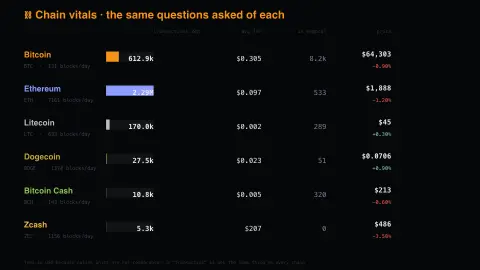
The Six Chains, Same Questions screensaver shows headline statistics for the major public blockchains side by side, read live and key-less from Blockchair. It's free, runs in your browser, and ESC exits.
Live preview
Press ESC to leave fullscreen. Settings are saved in your browser only.
How the Six Chains, Same Questions screensaver works
The saver reads the source described above and draws it on a canvas — no account, no tracking.
Headline statistics for the major public blockchains side by side, read live and key-less from Blockchair. Fees are shown in dollars because native units run from satoshis to wei, and block heights are left out because block times are not comparable.
It refreshes on a schedule, so what you see stays current.
Colours and any options can be changed in settings; nothing is stored beyond your own browser.
One word, different units
Blockchair is a blockchain explorer and search service that publishes statistics for several public networks through one API. This saver reads headline figures for the major chains and lays them side by side. Fields in Blockchair's statistics feed, as described by third-party tools that use it, include block count, transactions in the last 24 hours and the number of unconfirmed transactions waiting in the mempool, and key names can differ between chains.
Comparing chains is harder than it looks because the same word does not mean the same thing. A Bitcoin transaction moves coins between outputs, an Ethereum one can also call a program, and other networks count different kinds of operations, so equal transaction totals do not imply equal use. Native fee units also differ enormously in size, which is why the saver shows fees in dollars to give a common scale.
Block times differ between networks, which changes how often some statistics move; Bitcoin aims for about ten minutes per block. Dollar conversions depend on exchange rates at the time of the data. The display describes network activity and carries no view on any asset's value or on whether any chain is better than another.
A worked example
Headline statistics for the major public blockchains side by side, read live and key-less from Blockchair. Fees are shown in dollars because native units run from satoshis to wei, and block heights are left out because block times are not comparable.
Settings & tips
- Accent and Background recolour the display.
- Every value on screen comes from the live source — nothing is simulated.
- Press ESC to leave fullscreen.
Frequently asked questions
- Is this real data?
- Yes — it comes from the source named on this page and is refreshed on a schedule.
- Is a key needed?
- No. This source is fully key-less.
- Is it free?
- Yes, and it runs entirely in your browser.
- Why are fees shown in dollars?
- Each chain's native unit has a different size and price, so converting to dollars gives one common scale for comparison.
- Do more transactions mean a chain is more used?
- Not reliably. Chains define and bundle transactions differently, so raw counts are not directly comparable.