Austin 311 Screensaver
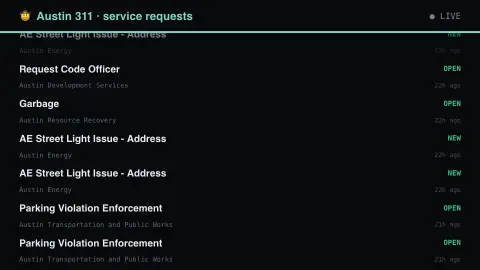
The Austin 311 screensaver shows service requests as residents file them with the City of Austin, from its key-less open-data portal: what was reported, which department owns it, and whether it is still open. It's free, runs in your browser, and ESC exits.
Live preview
Press ESC to leave fullscreen. Settings are saved in your browser only.
How the Austin 311 screensaver works
The saver reads the City of Austin open-data portal directly in your browser — no key and no account.
Service requests as residents file them with the City of Austin, from its key-less open-data portal: what was reported, which department owns it, and whether it is still open..
It refreshes on a schedule, so what you see stays current.
Colours can be changed in settings; nothing is stored beyond your own browser.
What a 311 line reveals about a city
311 is the non-emergency telephone number used by many North American cities, a place to report problems without tying up 911. In Austin, residents can reach 3-1-1 by phone, website or mobile app, around the clock, and each request is routed to the city department responsible. The city publishes service request records on its open-data portal, and also offers an Open311 endpoint for programmatic access.
Each row reflects the life of a request: what type of problem was reported, which department handles it, the date it was opened and whether it is still open or closed. The portal also records the channel a request came in through, such as phone, web or Open311. Because the data are a log of reports, they show where residents notice and report problems, which is not identical to where problems are most common.
That distinction matters. Neighbourhoods with more app users, more awareness of the service or stronger civic habits can generate more tickets without being worse off. Some records are withheld, for example those with information protected by the Texas Public Information Act, so the log is not a complete picture. It is a vivid slice of everyday city life, but not a measurement of service quality.
A worked example
Service requests as residents file them with the City of Austin, from its key-less open-data portal: what was reported, which department owns it, and whether it is still open.
Settings & tips
- Accent and Background recolour the display.
- Data comes straight from the City of Austin open-data portal in your browser.
- Press ESC to leave fullscreen.
Frequently asked questions
- Is this real data?
- Yes — it comes from the City of Austin open-data portal and is refreshed on a schedule.
- Is a key needed?
- No. This source is fully key-less.
- Is it free?
- Yes — free, no download, in your browser.
- Is 311 for emergencies?
- No. Anything involving immediate danger belongs with 911; 311 is for non-emergency city services.
- Does a closed request mean the issue was fixed?
- Not necessarily. Closed means the case is no longer open in the city’s system, which is not a guarantee about the outcome on the ground.
- Why might one area have more requests than another?
- Reporting rates depend on awareness, access to the app and local habits as well as on real conditions, so counts are not a direct measure of need.