Aircraft Airborne Screensaver
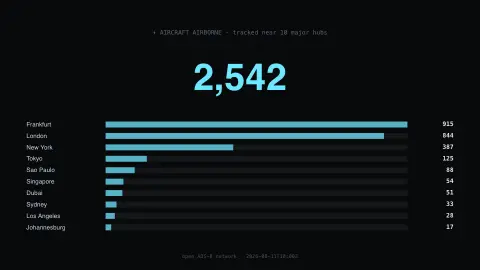
The Aircraft Airborne screensaver shows a live count of aircraft in the air within 250 nautical miles of ten major hubs, gathered key-less from the open ADS-B community network by the background pipeline. It's free, runs in your browser, and ESC exits.
Live preview
Press ESC to leave fullscreen. Settings are saved in your browser only.
How the Aircraft Airborne screensaver works
The background pipeline reads this from open ADS-B network and saves a snapshot the saver loads.
A live count of aircraft in the air within 250 nautical miles of ten major hubs, gathered key-less from the open ADS-B community network by the background pipeline..
It refreshes on a schedule, so what you see stays current.
Colours and the accent can be changed in settings; nothing is stored beyond your own browser.
How the airborne count is built
Aircraft with ADS-B Out transmit their identification, position, altitude and velocity automatically, with no interrogation needed; position and velocity reports go out roughly once a second. In the United States ADS-B Out has been required in much controlled airspace since 1 January 2020. Volunteers run receivers that pick up these signals and pool them into open networks such as adsb.lol, whose data is published under the Open Database License (ODbL 1.0), which is why a screensaver can use it.
This display counts aircraft in the air within 250 nautical miles of ten major hubs, so each place gets its own count and the figures are not additive. Circles around neighbouring hubs can overlap, so one aircraft can appear in more than one of them.
It is not a global census. Coverage depends on where volunteer receivers exist, so remote areas such as oceans are poorly covered, and aircraft without ADS-B are invisible. Owners can also ask for their aircraft to be blocked on some tracking services or to use a temporary alternate address, under programs such as LADD and PIA in the United States. The snapshot is a moment captured by the pipeline, not a live second-by-second view.
A worked example
A live count of aircraft in the air within 250 nautical miles of ten major hubs, gathered key-less from the open ADS-B community network by the background pipeline.
Settings & tips
- Accent and Background recolour the display.
- Run
automation/run.py airbornecountto refresh the feed. - Press ESC to leave fullscreen.
Frequently asked questions
- Is this real data?
- Yes — it comes from open ADS-B network and is refreshed on a schedule.
- Is a key needed?
- No. This source is fully key-less.
- Does it need an internet connection?
- Yes — it reads a live source, so it needs a connection to update.
- Is it free?
- Yes — free, no download, in your browser.
- Are all flights visible?
- No. Aircraft without ADS-B are absent, coverage depends on where volunteer receivers are, and privacy programs such as LADD and PIA let some owners limit what trackers show.
- Why do the same aircraft count in two hubs?
- The 250 nautical mile circles around nearby airports can overlap, so one plane may be counted in both.
- Where does the data come from?
- From adsb.lol, an open network of volunteer ADS-B receivers whose data is published under the ODbL 1.0 license.