Word Web Screensaver
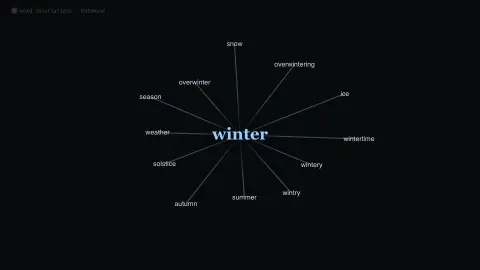
The Word Web screensaver shows a live semantic web grown from the key-less Datamuse API: a seed word sits at the centre, its closest relatives orbit it, and every few seconds one becomes the new centre — so the web wanders through the language. It's free, runs in your browser, and ESC exits.
Live preview
Press ESC to leave fullscreen. Settings are saved in your browser only.
How the Word Web screensaver works
The saver reads the Datamuse API directly in your browser — no key and no account.
A live semantic web grown from the key-less Datamuse API: a seed word sits at the centre, its closest relatives orbit it, and every few seconds one becomes the new centre — so the web wanders through the language..
It refreshes on a schedule, so what you see stays current.
Colours can be changed in settings; nothing is stored beyond your own browser.
What Datamuse knows about words
Datamuse is a word-finding API whose v1.1 was created by Doug Beeferman. It returns words matching constraints such as similar meaning, similar sound, spelling pattern, or words that tend to follow a given word in text. The "means like" query works as a reverse dictionary, while the "triggers" relation returns words statistically associated with the query word in the same text, for example cow with milking.
Results draw on several sources: Google Books Ngrams for a language model of word usage, WordNet and dictionaries crawled by OneLook for meanings, word2vec and the Paraphrase Database for related words, and the CMU Pronouncing Dictionary for sounds. Datamuse says results with a semantic constraint are sorted by strength of relationship, and otherwise by how common the word is in written text.
A link between two words can therefore mean they are synonyms, but also that they often occur together, such as a noun and a typical adjective. Associations like these reflect co-occurrence in text, the idea behind distributional semantics and J. R. Firth’s remark that you shall know a word by the company it keeps. Because results come from usage, ambiguous words like “bank” can mix senses, and the web can wander unexpectedly.
A worked example
A live semantic web grown from the key-less Datamuse API: a seed word sits at the centre, its closest relatives orbit it, and every few seconds one becomes the new centre — so the web wanders through the language.
Settings & tips
- Accent and Background recolour the display.
- Data comes straight from the Datamuse API in your browser.
- Press ESC to leave fullscreen.
Frequently asked questions
- Is this real data?
- Yes — it comes from the Datamuse API and is refreshed on a schedule.
- Is a key needed?
- No. This source is fully key-less.
- Is it free?
- Yes — free, no download, in your browser.
- Are the linked words synonyms?
- Not always. Some are synonyms, but others are words that frequently occur with or relate to the centre word, so a link means association.
- Where does Datamuse get its data?
- It combines sources including Google Books Ngrams, WordNet, the Paraphrase Database, word2vec and the CMU Pronouncing Dictionary.
- Why do some words pull in unrelated topics?
- Words with several meanings can gather neighbours from each sense, since the results come from usage patterns rather than a single dictionary definition.