Medicine, Pictured Screensaver
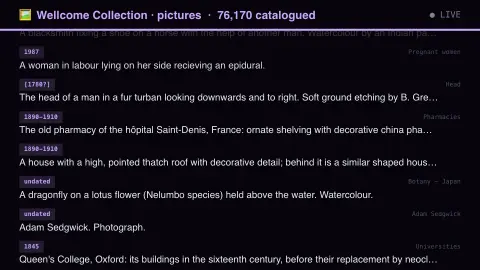
The Medicine, Pictured screensaver shows images from the Wellcome Collection, key-less — the visual history of medicine and the body. Dates are printed exactly as catalogued, including "n.d." and "[between 1800 and 1899?]", because the uncertainty is the real answer. It's free, runs in your browser, and ESC exits.
Live preview
Press ESC to leave fullscreen. Settings are saved in your browser only.
How the Medicine, Pictured screensaver works
The saver reads the source described above and draws it on a canvas — no account, no tracking.
Images from the Wellcome Collection, key-less — the visual history of medicine and the body. Dates are printed exactly as catalogued, including "n.d." and "[between 1800 and 1899?]", because the uncertainty is the real answer.
It refreshes on a schedule, so what you see stays current.
Colours and any options can be changed in settings; nothing is stored beyond your own browser.
What the Wellcome Collection holds
Wellcome Collection is a free museum and library on Euston Road in London that explores health, part of the charitable foundation Wellcome. It grew out of the collections of Henry Wellcome, an American-born pharmaceutical entrepreneur who became a British subject in 1910 and died in 1936. His will placed his company’s share capital with trustees to advance human and animal health, which became the Wellcome Trust.
Wellcome had a passion for collecting medically related artefacts, aiming at a Museum of Man, and by his death his holdings ran to more than a million items. The images shown here come from the library’s digitised material and include the kinds of things such a collection holds: anatomical illustrations, prints, posters and pages from manuscripts. They were catalogued over many years by different people, so the descriptions vary in detail and style.
Dates are given as the cataloguers recorded them, including approximate ranges and the note n.d. for undated, because many prints and manuscripts cannot be dated precisely. Some images are graphic depictions of surgery, illness or the dead, and older works may reflect assumptions now rejected. They are shown as historical documents, not as medical guidance.
A worked example
Images from the Wellcome Collection, key-less — the visual history of medicine and the body. Dates are printed exactly as catalogued, including "n.d." and "[between 1800 and 1899?]", because the uncertainty is the real answer.
Settings & tips
- Accent and Background recolour the display.
- Every value on screen comes from the live source — nothing is simulated.
- Press ESC to leave fullscreen.
Frequently asked questions
- Is this real data?
- Yes — it comes from the source named on this page and is refreshed on a schedule.
- Is a key needed?
- No. This source is fully key-less.
- Is it free?
- Yes, and it runs entirely in your browser.
- Who was Henry Wellcome?
- An American-born pharmaceutical entrepreneur and collector who died in 1936. His will created the trust that became the Wellcome Trust, a major biomedical charity.
- Why do some dates look vague?
- Cataloguers record what is known, so approximate ranges and n.d. appear when an item cannot be dated exactly.
- Are the images medical advice?
- No. They are historical artefacts, and many reflect outdated knowledge and attitudes.