Strange Attractors Screensaver
The Strange Attractors screensaver integrates three classic chaotic systems — Lorenz, Thomas and Halvorsen — and draws the resulting trajectory as a cloud of points. It runs in the browser with nothing to install; press ESC to exit.
Live preview
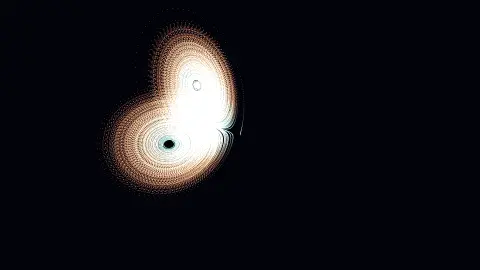
Press ESC to leave fullscreen. Settings are saved in your browser only.
How the Strange Attractors screensaver works
The saver renders with three.js on your GPU. The library is vendored into this site rather than fetched from a CDN, and is loaded only when a 3D screensaver actually runs.
It reads nothing external — the trajectories are computed in the browser from the published equations.
The scene resizes with the window and releases its WebGL context when the saver stops, so shuffle mode and Multi-view can cycle 3D savers without exhausting the browser's context limit.
If WebGL is unavailable the saver says so on screen rather than showing an empty black box.
Chaos drawn from simple equations
In 1963 the meteorologist Edward Lorenz published a three-equation model of atmospheric convection, a simplified description of fluid heated from below and cooled from above. Earlier, while rerunning a weather simulation, he had typed in 0.506 instead of 0.506127 and watched the new run diverge completely from the original. That sensitivity became known as chaos, and the shape his solution traces, two loops resembling wings, is the Lorenz attractor.
An attractor is the set of states a system tends towards. In a chaotic system the path never repeats and never settles, yet it stays confined to a bounded shape of intricate structure; the Lorenz attractor is a fractal with a dimension of about 2.06, which is why it is called strange. Other famous examples include the Rössler, Aizawa and Thomas systems, each defined by a handful of terms, each producing its own form.
The trajectory is calculated by stepping the equations forward in time with a numerical method, so each new point depends on the previous one. Drawing a very long path reveals the structure, with regions that are visited often looking brighter. Because of sensitive dependence, two paths starting a hair apart follow the same overall pattern but become unrelated in detail, so the long-term trajectory is unpredictable while the overall shape is not.
A worked example
Each system is three ordinary differential equations. Starting from a single point and stepping forward 180,000 times produces a path that never repeats and never escapes, winding forever around a shape with structure at every scale. Because one point is plotted per step, the density of the cloud is literally how much time the system spends in that region, and the colour tracks speed, so the fast unstable arcs stand out from the slow ones.
Settings & tips
- Accent and Background recolour the scene; Speed changes the pace of both the motion and the camera.
- Add it to a Multi-view grid, though 3D savers are heavier than the 2D ones and a few per screen is plenty.
- Press ESC at any time to leave fullscreen.
Frequently asked questions
- What makes an attractor strange?
- That it is bounded but never repeats. The trajectory stays inside a finite region forever, yet never passes through exactly the same state twice, and two paths starting arbitrarily close together diverge — which is the formal definition of chaos.
- Is the Lorenz one the butterfly?
- Yes. Lorenz derived it in 1963 as a stripped-down model of convection, and the two-lobed shape it traces is the origin of the phrase butterfly effect.
- Does this need a special browser or plugin?
- No. It uses WebGL, which every current desktop and mobile browser supports. Nothing is installed and no plugin is required.
- Does it cost anything or need an account?
- No. Every screensaver here is free, runs in the browser and needs no sign-up.
- Is chaos the same as randomness?
- No. A chaotic system follows exact deterministic rules, with no random input. It looks unpredictable because small differences grow rapidly.
- Why do attractors have fractal structure?
- The flow stretches and folds trajectories repeatedly, which layers the path into ever finer sheets. The Lorenz attractor has a fractal dimension of about 2.06.
- Did the butterfly effect come from Lorenz?
- Yes, in a sense. His 1972 talk was given the title “Does the flap of a butterfly’s wings in Brazil set off a tornado in Texas?”, a title suggested by Philip Merilees. It is a metaphor for sensitivity to starting conditions, not a literal claim about butterflies.