Snowfall Screensaver
Snowfall is a free ambient screensaver that fills your screen with snow drifting down on the wind, gently building up into a snow bank at the bottom. It runs entirely in your browser with nothing to download, and you press ESC at any time to exit. You can also flip it to rain mode for a different mood.
Live preview
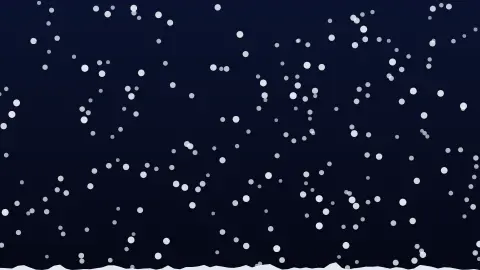
Press ESC to leave fullscreen. Settings are saved in your browser only.
How the Snowfall screensaver works
Snowfall scatters a field of flakes across the canvas and lets each one fall at its own speed, with closer, larger flakes drifting faster than the small, distant ones. A wind value nudges every flake sideways, and snow flakes also weave with a gentle side-to-side sway so the fall never looks mechanical.
When the Accumulate toggle is on, flakes that reach the floor add to a snow bank that slowly rises across the width of the screen, spreading a little to each side so the drift builds a soft, uneven crest. Once a column of snow reaches its cap, new flakes simply respawn at the top and fall again.
Switching Mode to Rain turns the round flakes into fast vertical streaks and disables the pile-up, while the Sky setting paints the backdrop as a Night, Day or Dusk gradient behind everything.
Why snow falls the way it does
A snowflake begins as an ice crystal, and the six-fold symmetry comes from the hexagonal lattice that water molecules form in ice. The six arms grow independently but experience the same changing conditions, so they develop alike. Which shape forms depends on temperature and humidity: needles and columns appear around −6 °C, large branched stellar crystals form mainly near −15 °C, and high humidity gives more elaborate branching while low humidity gives simple prisms.
What people call a snowflake is often many crystals that collided and stuck together in the air. Large aggregates about 10 mm across have been measured falling at roughly 1 m/s, far slower than rain, and fall speed depends on the type and mass of the particle. A flake falls slowly because it has a lot of surface for its small mass, so air resistance balances its weight at a low speed.
On screen the depth cue is motion parallax, the same effect you get from a car window. Nearby flakes seem to cross your field of view quickly while distant ones barely seem to move, even when they are all falling at similar real speeds. That is what makes a flat canvas feel like falling weather.
A worked example
With the defaults — Density 250, Wind 2, Mode: Snow, Accumulate on and Sky: Night — you get a calm night scene with a few hundred flakes drifting gently to the right and a snow bank slowly forming along the bottom. Push Density toward 600 and Wind to 10 for a driving blizzard, or set Mode to Rain and Sky to Dusk for a moody rainfall with no accumulation.
Settings & tips
- Use the Wind slider (range -10 to 10) to blow snow left or right; negative values send it the other way, and zero gives a straight, still fall.
- Turn off Accumulate if you prefer a clean screen with no snow bank building up at the bottom.
- Raise Density toward its 600 maximum for a thick blizzard, or drop it near 50 for a few sparse, peaceful flakes.
Frequently asked questions
- Is the snowfall screensaver free?
- Yes. Snowfall is completely free and runs in your web browser with no download, no sign-up and no install. Just open the page and let it play.
- How do I exit the snowfall screensaver?
- Press the ESC key to exit at any time. Moving the mouse or pressing any key also returns you to the page.
- Can I make it rain instead of snow?
- Yes. Set the Mode control to Rain and the flakes become fast vertical streaks. Rain mode does not accumulate at the bottom of the screen.
- Why does the snow pile up at the bottom?
- When Accumulate is enabled, flakes that reach the floor add to a snow bank that slowly rises. You can turn Accumulate off to keep the bottom of the screen clear.
- Does the snowfall screensaver work on any browser?
- Yes. It runs in any modern browser on desktop or laptop with no plugins. Open it full screen for the best effect and press ESC to leave.
- Why do snowflakes have six sides?
- Water molecules in ice arrange themselves in a hexagonal lattice, and a growing crystal’s six arms all experience the same changing conditions, so they develop alike.
- Does snow really fall slower than rain?
- Yes. Raindrops generally fall much faster than snow. Measurements of large snow aggregates give speeds of roughly 1 m/s, and the figure varies with the type and mass of the snow.
- Are no two snowflakes alike?
- Each crystal takes a slightly different path through the clouds and so meets different changes in temperature and humidity as it grows. That is why complex crystals are not expected to repeat exactly.