Public Randomness Screensaver
The Public Randomness screensaver shows the NIST Randomness Beacon, which publishes 512 fresh random bits every sixty seconds, key-less. It's free, runs in your browser, and ESC exits.
Live preview
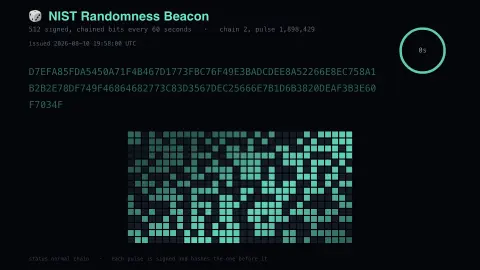
Press ESC to leave fullscreen. Settings are saved in your browser only.
How the Public Randomness screensaver works
The saver reads the source described above and draws it on a canvas — no account, no tracking.
The NIST Randomness Beacon, which publishes 512 fresh random bits every sixty seconds, key-less. The point is not the randomness but the proof: each pulse is signed and hashes the one before it, so anyone can verify a value existed at a given minute and was not chosen later.
It refreshes on a schedule, so what you see stays current.
Colours and any options can be changed in settings; nothing is stored beyond your own browser.
What a randomness beacon is for
The NIST Randomness Beacon is a public service run by the US National Institute of Standards and Technology. It publishes a fresh 512-bit random string once a minute, combining entropy from at least two separate random number generators, one of which is a quantum generator based on photon detection developed at NIST. The beacon idea was described by the cryptographer Michael Rabin in a 1983 paper, and its point is public, timestamped randomness that anybody can reference.
Each published record, called a pulse, is indexed, time-stamped and signed, and the sequence of pulses forms a hash chain. That makes the history tamper-evident: a value cannot be quietly replaced afterward without breaking the chain. It also means a lottery, a research draw or an audit can say its seed came from a given pulse, and others can check it was not chosen after the fact.
NIST warns not to use beacon values as cryptographic secret keys. Because the values are public the moment they are released, they are useless for anything that must stay secret. They suit transparent, verifiable choices, where anyone should be able to see how a random decision was made.
A worked example
The NIST Randomness Beacon, which publishes 512 fresh random bits every sixty seconds, key-less. The point is not the randomness but the proof: each pulse is signed and hashes the one before it, so anyone can verify a value existed at a given minute and was not chosen later.
Settings & tips
- Accent and Background recolour the display.
- Every value on screen comes from the live source — nothing is simulated.
- Press ESC to leave fullscreen.
Frequently asked questions
- Is this real data?
- Yes — it comes from the source named on this page and is refreshed on a schedule.
- Is a key needed?
- No. This source is fully key-less.
- Is it free?
- Yes — free, no download, in your browser.
- Can I use these bits as a password or encryption key?
- No. The values are published openly, so anyone can read them. NIST says plainly not to use beacon values as cryptographic secret keys.
- What is a pulse?
- A pulse is one record published by the beacon: an indexed, time-stamped, signed 512-bit random string, linked into a hash chain with the pulses around it.
- Why chain the pulses together?
- Linking pulses in a hash chain makes the history tamper-evident, so a value cannot be quietly replaced later without detection.