Pinball Wizard Table Screensaver
The Pinball Wizard Table screensaver is a self-playing, attract-mode tribute to the classic pinball table, with real ball physics. It is free, runs in your browser, and ESC exits.
Live preview
Press ESC to leave fullscreen. Settings are saved in your browser only.
How the Pinball Wizard Table screensaver works
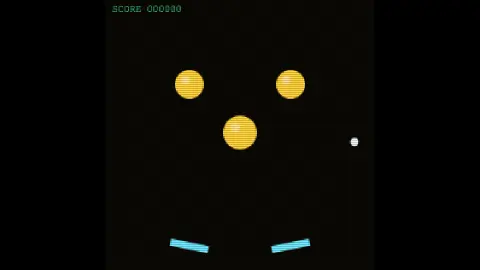
A ball bounces around a pinball table using real elastic-collision physics against bumpers and walls.
Self-timed flippers launch the ball back up the table whenever it drifts toward the bottom.
Bumper hits add to a running score, with a combo bonus for rapid consecutive hits.
All art and names here are original, in the spirit of the genre rather than a copy of any one table.
The physics behind a pinball table
Pinball descends from outdoor ball games and tabletop bagatelle. Coin-operated games arrived in 1931, with Gottlieb’s Baffle Ball an early hit. Bumpers came before flippers, and Gottlieb’s Humpty Dumpty of 1947 was the first game with player-controlled flippers, which by the early 1950s had settled into the familiar two-flipper layout at the bottom of the playfield.
A table is tilted slightly toward the player, so the ball accelerates down the playfield and every feature is really an energy injection. A pop bumper actively kicks the ball away faster than it arrived, which is why a ball can ricochet between several bumpers in a row and score a long chain of hits. A flipper is a short, fast-swinging bat; the point of impact along its length decides how hard and in which direction the ball leaves.
Machines also carry tilt sensors, such as a plumb bob or impact switch, that detect excessive nudging and penalise the player. This page is a demonstration in the spirit of an attract-mode loop, with a layout that is an original design rather than a copy of any licensed table.
A worked example
The ball ricochets between two bumpers in quick succession, triggering a combo bonus before a flipper sends it rocketing back up the table.
Settings & tips
- Accent recolours the bumpers and ball trail.
- Runs in self-playing attract mode, like a classic arcade cabinet's demo screen.
- Original art and names — an homage, not a copy.
Frequently asked questions
- Can I play this myself?
- It runs in self-playing attract mode, like a classic arcade cabinet between games.
- Is this a real table?
- No — it is an original tribute inspired by the classic pinball table genre.
- Is a key needed?
- No — it runs entirely locally.
- Is it free?
- Yes — free, no download, in your browser.
- Why do real pinball balls sometimes seem to speed up on their own?
- Pop bumpers are active: they push the ball away, so it can leave with more speed than it arrived with. Gravity on the sloped playfield adds to that on every downhill run.
- What is the tilt sensor on a real machine?
- A tilt mechanism, such as a plumb bob or an impact sensor, detects when a player nudges or shoves the cabinet too hard. A tilt is penalised, and modern machines usually give warnings first.