Everyone With a Researcher ID Screensaver
The Everyone With a Researcher ID screensaver shows the ORCID public registry, key-less. ORCID solves one dull enormous problem: two researchers with the same name, or one who changed theirs. The API returns XML unless an Accept header asks otherwise, so that header is not optional. It's free, runs in your browser, and ESC exits.
Live preview
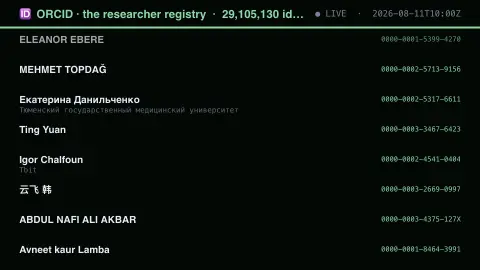
Press ESC to leave fullscreen. Settings are saved in your browser only.
How the Everyone With a Researcher ID screensaver works
The saver reads the source described above and draws it on a canvas — no account, no tracking.
The ORCID public registry, key-less. ORCID solves one dull enormous problem: two researchers with the same name, or one who changed theirs. The API returns XML unless an Accept header asks otherwise, so that header is not optional.
It refreshes on a schedule, so what you see stays current.
Colours and any options can be changed in settings; nothing is stored beyond your own browser.
What an ORCID iD actually is
ORCID (Open Researcher and Contributor ID) is a global not-for-profit organisation that provides researchers with a free persistent identifier, a 16-character iD written in four groups such as 0000-0002-1825-0097. The iD belongs to the person rather than to an employer or a journal, so it follows them when they change institution or name. Member organisations such as publishers, funders and universities connect to it through APIs.
Researchers create and maintain their own record, and they control its privacy settings. Items can be public, visible to trusted parties only, or private, and the public view contains only what the holder has made visible to everyone. That is why public records range from an empty shell to a full publication list. Each item also records its source, meaning the person or organisation client that added it.
An ORCID record is a pointer to a person, not a certificate of credentials. A registered iD does not by itself verify that listed works or affiliations are accurate, so treat the contents as claims by the record’s owner or by the source shown on each item.
A worked example
The ORCID public registry, key-less. ORCID solves one dull enormous problem: two researchers with the same name, or one who changed theirs. The API returns XML unless an Accept header asks otherwise, so that header is not optional.
Settings & tips
- Accent and Background recolour the display.
- Every value on screen comes from the live source — nothing is simulated.
- Press ESC to leave fullscreen.
Frequently asked questions
- Is this real data?
- Yes — it comes from the source named on this page and is refreshed on a schedule.
- Is a key needed?
- No. This source is fully key-less.
- Is it free?
- Yes, and it runs entirely in your browser.
- Is an ORCID iD verified by anyone?
- The iD identifies a record, not a verified set of credentials. Each item shows its source, which tells you who added it, but that is not a formal credential check.
- Why do some records look empty?
- Many people register and add little, or keep their details private. The public view only shows items the owner has made visible to everyone.