NYC Restaurant Inspections Screensaver
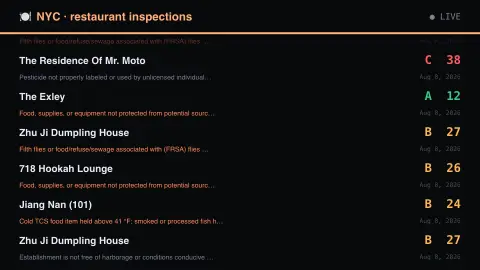
The NYC Restaurant Inspections screensaver shows real health inspection results from New York City's key-less open-data portal: the restaurant, what was cited, and the score it earned. Lower scores are better, and the city's letter grades follow from them. It's free, runs in your browser, and ESC exits.
Live preview
Press ESC to leave fullscreen. Settings are saved in your browser only.
How the NYC Restaurant Inspections screensaver works
The saver reads NYC Open Data directly in your browser — no key and no account.
Real health inspection results from New York City's key-less open-data portal: the restaurant, what was cited, and the score it earned.
It refreshes on a schedule, so what you see stays current.
Colours can be changed in settings; nothing is stored beyond your own browser.
How a New York City inspection is recorded
The New York City Department of Health and Mental Hygiene (DOHMH) inspects restaurants and publishes the results on NYC Open Data as the dataset DOHMH New York City Restaurant Inspection Results. The Health Department says its inspections are unannounced and happen at least once a year. Each restaurant is identified by a CAMIS record number.
Violations of food safety rules carry point values, and a restaurant’s score corresponds to a letter grade; a lower score means a better grade. The dataset has one row per violation, with an inspection’s other fields repeated on each row, so a single visit can produce several entries. A clean inspection gets a single row marked as having no violations. A grade code of P means pending.
The dataset covers sustained or not-yet-adjudicated violations from inspections up to three years before the most recent one. A 1/1/1900 inspection date marks a new establishment that has not yet been inspected, and the city warns that the data may contain errors and gaps. A record reflects what an inspector cited on one day, not an ongoing condition, and the display does not say which places are safe or unsafe to eat in.
A worked example
Real health inspection results from New York City's key-less open-data portal: the restaurant, what was cited, and the score it earned. Lower scores are better, and the city's letter grades follow from them.
Settings & tips
- Accent and Background recolour the display.
- Data comes straight from NYC Open Data in your browser.
- Press ESC to leave fullscreen.
Frequently asked questions
- Is this real data?
- Yes — it comes from NYC Open Data and is refreshed on a schedule.
- What does the score mean?
- They are penalty points, so lower is better: roughly 0–13 earns an A, 14–27 a B, and 28 or more a C. The letter shown follows that scale.
- Is a key needed?
- No. This source is fully key-less.
- Is it free?
- Yes — free, no download, in your browser.
- Why does the same restaurant appear several times?
- The dataset stores one row per violation, so one inspection with several violations produces several rows.
- Do inspections happen on a schedule?
- They are unannounced. The Health Department says restaurants are inspected at least once a year.
- Is a lower score better?
- Yes. Violations add points, and the score corresponds to a letter grade, so a lower score means a better grade.