Lobbying Disclosures Screensaver
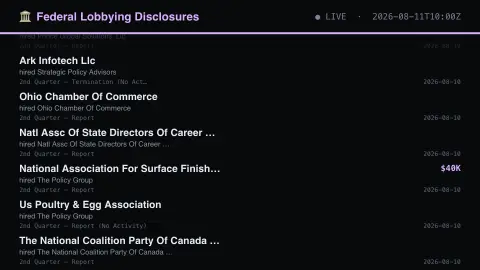
The Lobbying Disclosures screensaver shows real federal lobbying filings from the US Senate's key-less LDA database: who was hired, by whom and for which reporting period. Many filings report no dollar figure, so amounts show only when filed. It's free, runs in your browser, and ESC exits.
Live preview
Press ESC to leave fullscreen. Settings are saved in your browser only.
How the Lobbying Disclosures screensaver works
The background pipeline reads this from the US Senate LDA database and saves a snapshot the saver loads.
Real federal lobbying filings from the US Senate's key-less LDA database: who was hired, by whom and for which reporting period.
It refreshes on a schedule, so what you see stays current.
Colours can be changed in settings; nothing is stored beyond your own browser.
How US lobbying disclosure works
In the United States, the Lobbying Disclosure Act requires lobbying firms, and organisations that employ their own lobbyists, to register and file reports with the Secretary of the Senate and the Clerk of the House. The Senate's LDA database is where the filings are searchable. A lobbying contact is an oral or written communication to a covered official, such as a Member of Congress, congressional staff or certain executive-branch officials, about legislation, rules, federal programs or Senate-confirmed nominations. Lobbying activities also include research and background work intended for use in such contacts.
A filing names a registrant, the lobbying firm or the organisation lobbying for itself, and a client, the party that employs or retains it. A separate quarterly report is filed for each client, due within 20 days after the quarter ends, and lists the issues, bill numbers where practicable, the chambers and agencies contacted and the lobbyists involved. Firms give a good-faith income estimate per client and self-lobbying organisations an expense estimate. Amounts over $5,000 are rounded to the nearest $10,000, and smaller ones are reported as "less than $5,000", which is why many entries carry no useful dollar value. Lobbyists and registrants also file semiannual reports on certain political contributions.
Seeing a client name on the board says only that a filing exists. It does not describe what was asked of government or whether the lobbying succeeded, and the Act's reporting rules apply to registrants above the registration thresholds, so some small lobbying efforts never appear.
A worked example
Real federal lobbying filings from the US Senate's key-less LDA database: who was hired, by whom and for which reporting period. Many filings report no dollar figure, so amounts show only when filed.
Settings & tips
- Accent and Background recolour the display.
- Run
automation/run.py lobbyingto refresh the feed. - Press ESC to leave fullscreen.
Frequently asked questions
- Is this real data?
- Yes — it comes from the US Senate LDA database and is refreshed on a schedule.
- Why do some filings show no amount?
- Because many filings genuinely report none. The figure is shown only when the filing itself carries one, rather than guessing a value.
- Is a key needed?
- No. This source is fully key-less.
- Is it free?
- Yes — free, no download, in your browser.
- What is the difference between a registrant and a client?
- The registrant is the lobbying firm, or the organisation lobbying for itself, that files the report. The client is the party that employs or retains the registrant to lobby on its behalf.
- Why do filings come in quarterly and semiannual forms?
- The Act requires a quarterly report on lobbying activity for each client, and a separate semiannual report on certain political contributions, so different filing types appear in the stream.
- Does a filing mean someone influenced a law?
- No. It records that lobbying activity was registered and reported, not what was discussed or what result followed.