What Canada Just Approved Screensaver
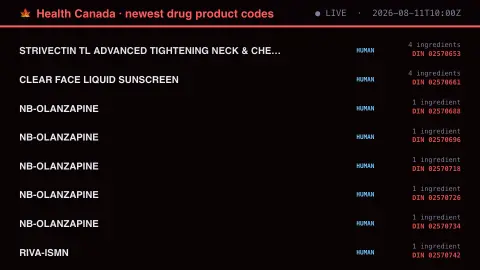
The What Canada Just Approved screensaver shows drug products newly added to Health Canada's register, key-less. A Drug Identification Number is assigned per product rather than per molecule — the same active ingredient carries a different DIN for every strength, format and manufacturer — which is why sunscreens sit beside prescription medicines. It's free, runs in your browser, and ESC exits.
Live preview
Press ESC to leave fullscreen. Settings are saved in your browser only.
How the What Canada Just Approved screensaver works
The saver reads the source described above and draws it on a canvas — no account, no tracking.
Drug products newly added to Health Canada's register, key-less. A Drug Identification Number is assigned per product rather than per molecule — the same active ingredient carries a different DIN for every strength, format and manufacturer — which is why sunscreens sit beside prescription medicines.
It refreshes on a schedule, so what you see stays current.
Colours can be changed in settings; nothing is stored beyond your own browser.
What a Drug Identification Number is
Health Canada is the federal department that regulates drugs and health products sold in Canada. A drug product receives an eight-digit Drug Identification Number, or DIN, before it is marketed. The number is computer-generated and assigned randomly, so the digits carry no hidden meaning, and the DIN is printed on the label of authorised prescription and over-the-counter products.
The number identifies a product, not a molecule: it is tied to the manufacturer, product name, active ingredients, strengths, pharmaceutical form and route of administration. The same active ingredient therefore appears under many DINs, one for each strength, brand and maker. That is why generics can sit next to novel medicines in a stream, and why over-the-counter products hold DINs too.
The Drug Product Database that lists these records covers products for human use, veterinary use, disinfectants and radiopharmaceuticals, and its data includes marketed, cancelled and dormant products as well as approved ones. A new row means a product has been registered, which is not the same as a new treatment being invented. A DIN is not a guarantee of safety or effectiveness, so the board is no substitute for the product monograph or professional advice.
A worked example
Drug products newly added to Health Canada's register, key-less. A Drug Identification Number is assigned per product rather than per molecule — the same active ingredient carries a different DIN for every strength, format and manufacturer — which is why sunscreens sit beside prescription medicines.
Settings & tips
- Accent and Background recolour the display.
- Every value on screen comes from the live source — nothing is simulated.
- Press ESC to leave fullscreen.
Frequently asked questions
- Is this real data?
- Yes — it comes from the source named on this page and is refreshed on a schedule.
- Is a key needed?
- No. This source is fully key-less.
- Is it free?
- Yes, and it runs entirely in your browser.
- Does a DIN mean a new drug?
- No. It means a specific product has been assigned a number by Health Canada before sale, and many are new brands or strengths of established ingredients.
- Do the digits of a DIN mean anything?
- No. Health Canada says the eight-digit numbers are assigned randomly by a computer-generated system.
- Does the register include veterinary products?
- Yes. The Drug Product Database covers human, veterinary, disinfectant and radiopharmaceutical products.