What the Genome Tracks With Screensaver
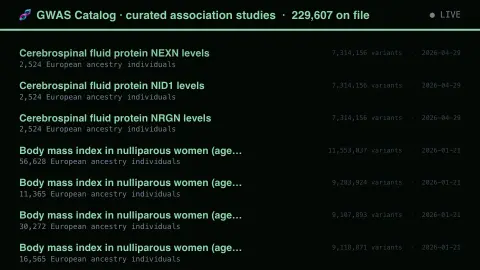
The What the Genome Tracks With screensaver shows studies from the NHGRI-EBI GWAS Catalog, key-less. The API offers no working sort — asking for newest-first returns 2008 records — so recent studies are reached by computing the last page from the reported total. The catalogue is curated in batches, so this is most recently curated, not most recently published. It's free, runs in your browser, and ESC exits.
Live preview
Press ESC to leave fullscreen. Settings are saved in your browser only.
How the What the Genome Tracks With screensaver works
The saver reads the source described above and draws it on a canvas — no account, no tracking.
Studies from the NHGRI-EBI GWAS Catalog, key-less. The API offers no working sort — asking for newest-first returns 2008 records — so recent studies are reached by computing the last page from the reported total. The catalogue is curated in batches, so this is most recently curated, not most recently published.
It refreshes on a schedule, so what you see stays current.
Colours and any options can be changed in settings; nothing is stored beyond your own browser.
What a genome-wide association study finds
A genome-wide association study, or GWAS, scans the genomes of many people, looking for single-letter DNA differences called variants that occur more or less often in people with a given trait or disease. The GWAS Catalog was founded by the National Human Genome Research Institute in 2008 and has been a collaboration between NHGRI and EMBL-EBI since 2010, with EMBL-EBI hosting the website and infrastructure. Curators find eligible published studies through literature search and record the reported trait, the significant variant-trait associations and sample metadata.
The important word is association. A variant that sits near a gene linked to a trait is a statistical marker, not necessarily a cause. Variants inherited together in blocks may be correlated, so the one flagged is often a stand-in for a neighbour. Most traits are shaped by many variants of small effect together with environment, so a single hit seldom predicts much about an individual.
The catalogue also reflects who has been studied: variant frequencies differ between populations, so findings from one ancestry group may transfer unevenly to others. Traits range widely, and the entries show what was studied and reported, not what has been proven clinically.
A worked example
Studies from the NHGRI-EBI GWAS Catalog, key-less. The API offers no working sort — asking for newest-first returns 2008 records — so recent studies are reached by computing the last page from the reported total. The catalogue is curated in batches, so this is most recently curated, not most recently published.
Settings & tips
- Accent and Background recolour the display.
- Every value on screen comes from the live source — nothing is simulated.
- Press ESC to leave fullscreen.
Frequently asked questions
- Is this real data?
- Yes — it comes from the source named on this page and is refreshed on a schedule.
- Is a key needed?
- No. This source is fully key-less.
- Is it free?
- Yes, and it runs entirely in your browser.
- Does an associated variant cause the trait?
- Not necessarily. Association is statistical, and the flagged variant may simply travel with the real causal one on the same stretch of DNA.
- Can these results predict my own health?
- A single association usually has a very small effect, and this display is not a clinical or personal risk tool.
- Who runs the GWAS Catalog?
- It was founded by NHGRI in 2008 and has been a collaboration between NHGRI and EMBL-EBI since 2010, with EMBL-EBI hosting the website and infrastructure.