Flying Toasters Screensaver
Flying Toasters is the classic After Dark screensaver where winged chrome toasters flap across the screen while slices of toast drift past. This free browser version flies the toasters left to right in 3D; set how many there are and how fast they go, then run it fullscreen and press ESC to exit.
Live preview
Press ESC to leave fullscreen. Settings are saved in your browser only.
How the Flying Toasters screensaver works
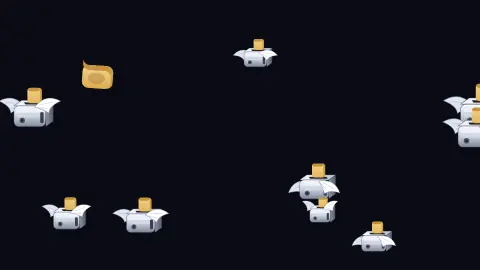
Each toaster is drawn as a small 3D object every frame — a chrome body with a lit top face, a shaded side face, a slot with a slice of toast poking out, and two wings. There's no video file: the whole scene is painted onto an HTML5 canvas dozens of times a second.
Every toaster carries its own position, speed and a wing-flap timer. On each frame the saver advances the position rightward, nudges it up and down with a gentle sine wave so it bobs like a bird, and advances the flap timer so the wings sweep up and down. Slices of toast use the same motion with a slower spin.
When a toaster passes the right edge it is recycled: a fresh one re-enters from the left at a new height and speed. Because there are always several on screen at staggered depths, the flock looks continuous. The density control sets how many objects exist at once and speed scales how fast they cross.
Drawing in 3D each frame — rather than playing a clip — is what lets the toasters change count, speed and colour instantly without any pre-rendered assets, and keeps the file size tiny.
After Dark and the legend of Flying Toasters
Flying Toasters came from After Dark, a screensaver package developed by Berkeley Systems and first released in 1989 for the Apple Macintosh. A Windows version followed in the early 1990s. Winged chrome toasters flapped across the screen alongside slices of toast, a surreal premise that became one of the best-known pieces of software art of its era.
Wikipedia credits After Dark's original authors as Jack Eastman and Patrick Beard, and records Eastman saying he imagined the winged toasters after seeing a kitchen toaster during a late-night programming session. The toasters are often compared to the cover art of Jefferson Airplane's 1973 album Thirty Seconds Over Winterland.
After Dark grew into a long product line. Its default module was Starry Night, other modules included Fish, Bad Dog and Mowin' Man, and licensed editions covered Star Trek, The Simpsons and Looney Tunes. Berkeley Systems was acquired in 1997 by the Sierra On-Line division of CUC International. The toasters remain the package's signature image.
A worked example
Say you set density to 8 and speed to 6. The saver keeps 8 objects alive; on average about 30% of them (so 2–3) are toast slices and the rest are toasters. On a 1920-pixel-wide screen, a toaster moving at speed 6 crosses in roughly 25 seconds, so a new one enters from the left every few seconds as others exit on the right. Turn toast off and all 8 become toasters; turn the background from near-black to deep blue and the chrome picks up a cooler reflection.
Settings & tips
- Lower density for a calmer sky; raise it toward the maximum for a dense, chaotic flock.
- Drop speed to 1–2 for a dreamy slow drift, or push it up for a brisk commute.
- Switch toast off if you want pure toasters, or leave it on for the full After Dark effect.
Frequently asked questions
- Is the Flying Toasters screensaver free?
- Yes. It runs free in your browser with nothing to download or install. Open the page, press Run fullscreen, and press ESC to exit.
- Which direction do the toasters fly?
- Left to right across the screen, bobbing gently as their wings flap. The original After Dark version flew diagonally; this rebuild flies them horizontally in 3D.
- Can I change how many toasters there are?
- Yes. The density control sets how many toasters and toast slices are on screen at once, and the speed control sets how fast they cross.
- Does it work on a phone or tablet?
- It runs in any modern browser, but it's designed for a desktop or laptop screen where you can go fullscreen and leave it idle.
- Who created the original Flying Toasters?
- Flying Toasters debuted in Berkeley Systems' After Dark in 1989 and became the most recognisable screensaver ever made. This is an original browser re-creation of that effect.
- Who made the original Flying Toasters?
- They were part of After Dark, developed by Berkeley Systems, whose original authors were Jack Eastman and Patrick Beard. It debuted in 1989 on the Macintosh.
- What else was in After Dark?
- Many modules, including Starry Night (the default), Fish, Bad Dog and Mowin' Man, plus licensed editions such as Star Trek and The Simpsons.