Drug Classification Screensaver
The Drug Classification screensaver shows the WHO's Anatomical Therapeutic Chemical system from the NIH's key-less RxNav service, from the broad body system down to the specific chemical group — the whole taxonomy of what drugs are for. It's free, runs in your browser, and ESC exits.
Live preview
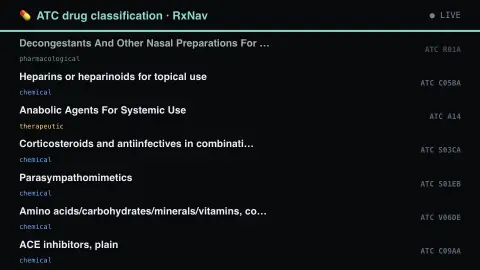
Press ESC to leave fullscreen. Settings are saved in your browser only.
How the Drug Classification screensaver works
The saver reads the NIH RxNav service directly in your browser — no key and no account.
The WHO's Anatomical Therapeutic Chemical system from the NIH's key-less RxNav service, from the broad body system down to the specific chemical group — the whole taxonomy of what drugs are for..
It refreshes on a schedule, so what you see stays current.
Colours can be changed in settings; nothing is stored beyond your own browser.
The ATC system and how drugs are classified
The Anatomical Therapeutic Chemical classification, known as ATC, is maintained by the WHO Collaborating Centre for Drug Statistics Methodology in Oslo, which is run by the Norwegian Institute of Public Health. It sorts active substances into groups by the organ or system they act on and by their therapeutic, pharmacological and chemical properties, and it supports drug utilization monitoring and research. RxNav is a browser and set of web services from the US National Library of Medicine for RxNorm, its standard drug terminology, and its RxClass service links RxNorm drug products to ATC classes (levels 1 to 4).
The classification has five levels. The first, a single letter, is one of 14 main anatomical groups, such as A for alimentary tract and metabolism. The second is a therapeutic or pharmacological subgroup, the third a pharmacological subgroup, the fourth a chemical subgroup, and the fifth the individual substance. A code reads as a path down this tree: metformin is A10BA02, where A10 is drugs used in diabetes, A10B blood glucose lowering drugs and A10BA biguanides.
A substance can receive more than one code when it is sold in different strengths or by different routes with clearly different therapeutic uses. Finasteride, for example, has one code for low-strength products and another for high-strength ones. The classification describes what a drug is used for in general; it is not a prescribing guide and says nothing about doses, safety or which treatment suits a person. For medical decisions, consult a clinician or pharmacist.
A worked example
The WHO's Anatomical Therapeutic Chemical system from the NIH's key-less RxNav service, from the broad body system down to the specific chemical group — the whole taxonomy of what drugs are for.
Settings & tips
- Accent and Background recolour the display.
- Data comes straight from the NIH RxNav service in your browser.
- Press ESC to leave fullscreen.
Frequently asked questions
- Is this real data?
- Yes — it comes from the NIH RxNav service and is refreshed on a schedule.
- What do the levels mean?
- ATC codes get more specific as they get longer: one character is a body system, three is a therapeutic group, four is pharmacological, and beyond that is the chemical group.
- Is a key needed?
- No. This source is fully key-less.
- Is it free?
- Yes — free, no download, in your browser.
- Who maintains the ATC classification?
- The WHO Collaborating Centre for Drug Statistics Methodology in Oslo, run by the Norwegian Institute of Public Health. It creates new entries on request from users such as manufacturers, regulators and researchers.
- Why can one drug have several ATC codes?
- A substance sold in different strengths or by different routes of administration with clearly different therapeutic uses can be placed in more than one group, so that each use is counted properly.
- Is ATC the same as a prescription category?
- No. ATC is a classification for drug utilization monitoring and research. It does not say whether a medicine needs a prescription or is legally controlled.