The Shape Of The Spell List Screensaver
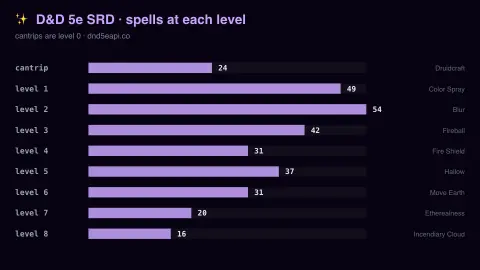
The Shape Of The Spell List screensaver charts how many D&D 5e SRD spells exist at each level, from cantrips through to ninth. The distribution is lopsided in a way players feel but rarely see plotted: levels one to three carry most of the list, and by ninth there are barely a dozen. It runs in the browser with nothing to install; press ESC to exit.
Live preview
Press ESC to leave fullscreen. Settings are saved in your browser only.
How the The Shape Of The Spell List screensaver works
The saver reads dnd5eapi.co, which serves the open-licensed 5e reference data.
No account and no key: the request goes straight from your browser, or from this site's own refreshed copy of the feed where the source does not allow browser access.
Values are drawn on a canvas that resizes with the window, so it works on a laptop or a wall display.
If the source is unreachable the saver says so on screen rather than showing stale numbers as though they were current.
The SRD and the shape of Fifth Edition magic
Dungeons & Dragons, first published in 1974 by Tactical Studies Rules, sorts magic into levels. In fifth edition a caster can use cantrips, level-zero spells that need no spell slot, and spells of level one through nine. Casting a spell of level one or higher expends a slot of that level or higher, and finishing a long rest restores expended slots.
The System Reference Document, or SRD, is the portion of the rules that Wizards of the Coast publishes for third-party creators. SRD 5.1 is released under both the Open Game License 1.0a and the Creative Commons Attribution 4.0 license, and Wizards of the Coast still owns the content it put in. The site dnd5eapi.co presents the 5e SRD as a REST API. The SRD holds only part of the spell catalogue in the printed books, so a chart built on it is not a census of every spell in the game.
Spell slots are what tie the levels together: a character can cast higher-level spells only once they hold slots of that level, so the top tiers are reached late in a character’s progression. Counts can also differ depending on whether a spell that appears on several class lists is counted once or per class, so the chart describes the reference document rather than the whole game.
A worked example
Ten bars, one per spell level, each with its count and a rotating example spell named on the right. Low levels dominate because those are the spells a character casts for a whole career; the ninth-level bar is a stub, and each spell in it is a campaign event rather than a combat option.
Settings & tips
- Accent and Background recolour the display without changing the data.
- Add it to a Multi-view grid to watch it alongside other live savers.
- Press ESC at any time to leave fullscreen.
Frequently asked questions
- Why does the saver make ten separate requests?
- Because the API's spell list returns names and a count but no level field, so the only way to get the distribution is one request per level. They are issued in sequence rather than all at once, because the service is free and hammering it ten-wide to save two seconds is rude.
- Is this every D&D spell?
- No — it is the System Reference Document, the openly licensed subset. The published rulebooks contain more spells that are not free to redistribute.
- Is this real data?
- Yes. It comes from dnd5eapi.co, which serves the open-licensed 5e reference data. Nothing is invented or simulated, and if the source cannot be reached the saver reports that instead of drawing something plausible.
- Does it cost anything or need an account?
- No. Every screensaver here is free, runs in the browser and needs no sign-up. This one uses a public API that requires no key.
- What is a spell slot?
- A limited resource a caster expends to cast a spell of level one or higher, using a slot of that level or higher. Finishing a long rest restores expended slots.
- Does the SRD include every spell in the rulebooks?
- No. It is an openly licensed subset, so many spells from the printed books are absent from it and from this chart.
- What is a cantrip?
- A level-zero spell that needs no spell slot, so it can be cast repeatedly.