Who Can Name A Flaw Screensaver
The Who Can Name A Flaw screensaver shows the organisations authorised to assign CVE numbers, key-less. It’s free, runs in your browser, and ESC exits.
Live preview
Press ESC to leave fullscreen. Settings are saved in your browser only.
How the Who Can Name A Flaw screensaver works
The saver reads the source described above and draws it on a canvas — no account, no tracking.
The organisations authorised to assign CVE numbers, key-less. Identifiers do not come from a central desk — the CVE Program delegates the right to vendors, national CERTs and bounty platforms, each only within a declared scope.
It refreshes on a schedule, so what you see stays current.
Colours and any options can be changed in settings; nothing is stored beyond your own browser.
How CVE Numbering Authorities fit together
The CVE Program gives each publicly known security vulnerability a unique identifier such as CVE-2026-12345. MITRE serves as the program’s Secretariat, handling administrative support and infrastructure, but the numbering itself is spread out: many organisations act as CVE Numbering Authorities, or CNAs, and each can assign numbers for flaws in its own territory.
A CNA’s territory is its declared scope. A software vendor may cover only its own products, a national CERT may cover vulnerabilities found within its country, a bug bounty platform may cover issues reported through it, and open-source projects may take care of their own code. Top-Level Roots report directly to the CVE Board and each oversees its own hierarchy of CNAs, which includes a CNA of last resort (CNA-LR) that can assign identifiers for vulnerabilities no other CNA’s scope covers.
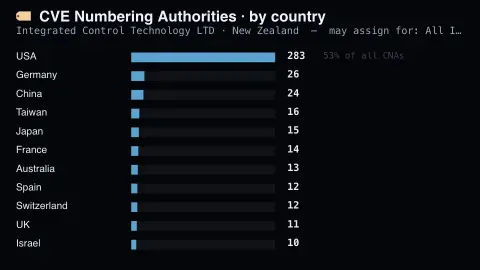
The list shows recently added authorities together with their country and scope text, plus a count by country. Being a CNA is permission to assign identifiers within a scope, not a mark of product quality or of the speed at which a company fixes issues.
A worked example
The organisations authorised to assign CVE numbers, key-less. Identifiers do not come from a central desk — the CVE Program delegates the right to vendors, national CERTs and bounty platforms, each only within a declared scope.
Settings & tips
- Accent and Background recolour the display.
- Every value on screen comes from the live source — nothing is simulated.
- Press ESC to leave fullscreen.
Frequently asked questions
- Is this real data?
- Yes — it comes from the source named on this page and is refreshed on a schedule.
- Is a key needed?
- No. This source is fully key-less.
- Is it free?
- Yes, and it runs entirely in your browser.
- What does a CNA of last resort do?
- It can assign CVE identifiers and publish records for vulnerabilities that no other CNA’s scope covers, working within the authority of the Root that sponsors it.
- What does a CNA’s scope mean?
- It defines the products or situations for which that organisation may assign CVE identifiers; outside it, reports go to another CNA.
- Does having a CNA mean a vendor is secure?
- No. It means the vendor can assign identifiers for its own flaws, and says nothing about how many flaws exist or how fast they are fixed.