A Small Language's Ecosystem Screensaver
The A Small Language's Ecosystem screensaver shows packages on Clojars, the community repository for Clojure, key-less. The scale is the point: where npm counts packages in millions, this counts in tens of thousands. A language with a small, coherent library set behaves differently from one with a vast one — there is usually one obvious way to do a thing, and the group name says who maintains it. It's free, runs in your browser, and ESC exits.
Live preview
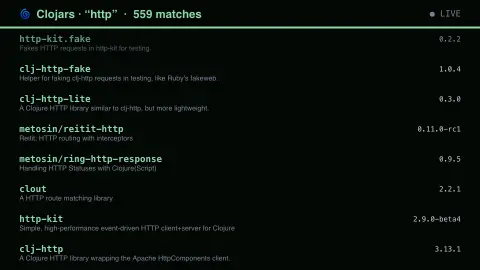
Press ESC to leave fullscreen. Settings are saved in your browser only.
How the A Small Language's Ecosystem screensaver works
The saver reads the source described above and draws it on a canvas — no account, no tracking.
Packages on Clojars, the community repository for Clojure, key-less. The scale is the point: where npm counts packages in millions, this counts in tens of thousands. A language with a small, coherent library set behaves differently from one with a vast one — there is usually one obvious way to do a thing, and the group name says who maintains it.
It refreshes on a schedule, so what you see stays current.
Colours can be changed in settings; nothing is stored beyond your own browser.
Clojars and the Clojure library world
Clojure is a modern Lisp for the Java Virtual Machine, created by Rich Hickey and released publicly in 2007. Clojars is the community repository where Clojure developers publish libraries; its own documentation says it is maintained voluntarily by community members and nobody works on it full time. Build tools that understand the Maven repository layout, including Leiningen, can use it.
The Clojure CLI's built-in Maven repositories are Maven Central, checked first, and Clojars. Libraries are identified by a Maven-style coordinate: a group, an artifact name and a version. Group names usually point to an organisation or a person, and Clojars suggests third-party packages use an org.clojars.username group. Once a non-SNAPSHOT version is deployed it cannot be redeployed, so each release creates another version and the repository is a record of packaging activity as much as of distinct ideas.
Size comparisons with other ecosystems are only a loose guide. Many Clojure programmers also pull in plain Java libraries from Maven Central, so a smaller Clojars catalogue does not mean fewer tools are available. It also holds forks, experiments and abandoned projects next to heavily used ones, and a recent upload says nothing about quality or adoption.
A worked example
Packages on Clojars, the community repository for Clojure, key-less. The scale is the point: where npm counts packages in millions, this counts in tens of thousands. A language with a small, coherent library set behaves differently from one with a vast one — there is usually one obvious way to do a thing, and the group name says who maintains it.
Settings & tips
- Accent and Background recolour the display.
- Every value on screen comes from the live source — nothing is simulated.
- Press ESC to leave fullscreen.
Frequently asked questions
- Is this real data?
- Yes — it comes from the source named on this page and is refreshed on a schedule.
- Is a key needed?
- No. This source is fully key-less.
- Is it free?
- Yes, and it runs entirely in your browser.
- What is a group ID?
- It is the first part of a library's coordinate and names the owner, often a reverse domain or a GitHub account. It keeps two libraries with the same artifact name from clashing.
- Why do Clojure developers also use Maven Central?
- Clojure runs on the JVM, so it can use any Java library. Maven Central hosts most of those, while Clojars hosts libraries written specifically for Clojure.
- Does a new upload mean a new library?
- Not always. Many entries are fresh releases of existing projects, forks, or small personal experiments, so recency is not a mark of novelty.