CERT/CC Notes Screensaver
The CERT/CC Notes screensaver shows vulnerability notes from the CERT Coordination Center at Carnegie Mellon, key-less. It’s free, runs in your browser, and ESC exits.
Live preview
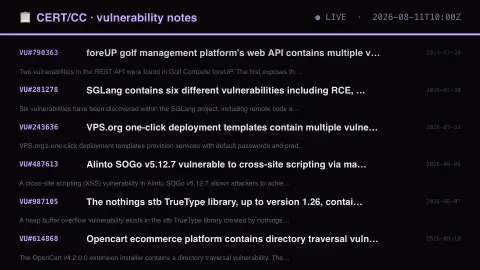
Press ESC to leave fullscreen. Settings are saved in your browser only.
How the CERT/CC Notes screensaver works
The saver reads the source described above and draws it on a canvas — no account, no tracking.
Vulnerability notes from the CERT Coordination Center at Carnegie Mellon, key-less. CERT/CC writes one only when a flaw needs coordinating across several vendors — a shared protocol, a common library, a chipset everybody ships — so the feed is slow by design.
It refreshes on a schedule, so what you see stays current.
Colours and any options can be changed in settings; nothing is stored beyond your own browser.
What the CERT/CC publishes
The CERT Coordination Center was founded in November 1988 in Pittsburgh, at DARPA's direction, in response to the Morris worm incident, and is regarded as the first organisation of its kind. Today the CERT Division of Carnegie Mellon University's Software Engineering Institute runs it, acting as a go-between among researchers who find flaws and vendors who must fix them.
Its vulnerability notes carry identifiers such as VU#645818 and include summaries, technical details, remediation information and lists of affected vendors. Most notes result from private coordination and disclosure efforts. A note is typically written when a problem touches many parties, such as a shared protocol, library or firmware component, where one vendor's patch is not enough, which is why the feed is far slower than a general CVE listing.
CERT/CC works privately with the vendor first, usually publishing jointly with the vendor's own advisory. If the vendor is unwilling to resolve the issue or cannot be contacted, it typically discloses publicly 45 days after the first contact attempt. A note can therefore appear before every vendor has a patch. The screen shows the summary only, not the full guidance.
A worked example
Vulnerability notes from the CERT Coordination Center at Carnegie Mellon, key-less. CERT/CC writes one only when a flaw needs coordinating across several vendors — a shared protocol, a common library, a chipset everybody ships — so the feed is slow by design.
Settings & tips
- Accent and Background recolour the display.
- Every value on screen comes from the live source — nothing is simulated.
- Press ESC to leave fullscreen.
Frequently asked questions
- Is this real data?
- Yes — it comes from the source named on this page and is refreshed on a schedule.
- Is a key needed?
- No. This source is fully key-less.
- Is it free?
- Yes, and it runs entirely in your browser.
- Why are there so few notes compared with CVE lists?
- CERT/CC writes a note only for problems needing multi-vendor coordination, so it covers a small, selective slice of all disclosed flaws.
- What does VU# mean?
- It prefixes the number that identifies a note in the CERT/CC vulnerability notes database, such as VU#645818. The number is separate from any CVE number.
- How long do vendors get before details are published?
- Typically 45 days after CERT/CC's first contact attempt if the vendor is unwilling to resolve the issue or cannot be contacted, according to its disclosure policy.