Brazil Legislating, Live Screensaver
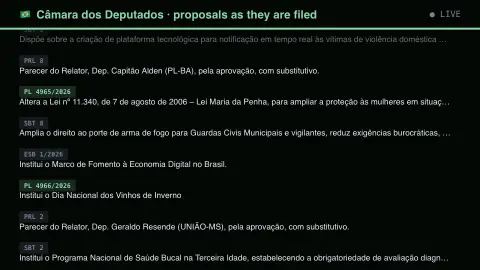
The Brazil Legislating, Live screensaver shows proposals arriving at Brazil's Chamber of Deputies, key-less. Ordering by id descending is what makes this a feed rather than an archive, since the Chamber issues ids sequentially as proposals are filed. The type code carries the weight — PEC is a constitutional amendment, MPV has force of law from signature — so it is coloured rather than left as text. It's free, runs in your browser, and ESC exits.
Live preview
Press ESC to leave fullscreen. Settings are saved in your browser only.
How the Brazil Legislating, Live screensaver works
The saver reads the source described above and draws it on a canvas — no account, no tracking.
Proposals arriving at Brazil's Chamber of Deputies, key-less. Ordering by id descending is what makes this a feed rather than an archive, since the Chamber issues ids sequentially as proposals are filed. The type code carries the weight — PEC is a constitutional amendment, MPV has force of law from signature — so it is coloured rather than left as text.
It refreshes on a schedule, so what you see stays current.
Colours can be changed in settings; nothing is stored beyond your own browser.
The Brazilian Chamber of Deputies and its proposals
The Câmara dos Deputados is the lower house of Brazil’s National Congress, with 513 deputies elected from the states and the Federal District. Its Dados Abertos service makes the Chamber’s information available for reuse through an API, including legislators, committees, events, votes and proposições, the legislative documents the saver draws on.
Proposals come in several kinds, each with its own abbreviation. PL is an ordinary bill, PLP a complementary law bill (needing an absolute majority), PEC a proposed constitutional amendment and PDL a legislative decree, which covers matters within Congress’s exclusive competence and needs no presidential sanction. MPV is a provisional measure: an act of the executive with force of law, which lapses if not converted into law within sixty days, a period that can be extended once by another sixty.
A proposal appearing on screen means only that it was filed. The summary line (ementa) is written in formal Portuguese, and the list shows ideas entering the chamber, not laws that result.
A worked example
Proposals arriving at Brazil's Chamber of Deputies, key-less. Ordering by id descending is what makes this a feed rather than an archive, since the Chamber issues ids sequentially as proposals are filed. The type code carries the weight — PEC is a constitutional amendment, MPV has force of law from signature — so it is coloured rather than left as text.
Settings & tips
- Accent and Background recolour the display.
- Every value on screen comes from the live source — nothing is simulated.
- Press ESC to leave fullscreen.
Frequently asked questions
- Is this real data?
- Yes — it comes from the source named on this page and is refreshed on a schedule.
- Is a key needed?
- No. This source is fully key-less.
- Is it free?
- Yes, and it runs entirely in your browser.
- What does a filed proposal actually mean?
- It means the proposal has been registered for consideration by the Chamber. Appearing in the feed says nothing about whether it will be voted on or become law.
- Why is the text in Portuguese?
- The data comes from the Chamber, which publishes in Portuguese. Summaries use formal legislative phrasing, so a translator may help for other languages.
- What is the difference between a PL and a PEC?
- A PL is an ordinary bill, while a PEC amends the Constitution. A PEC must be approved in two rounds in each house with three-fifths of the members, which is 308 of the 513 deputies.